06 Dec German kitchen
The concept of ”German kitchen” is extremely wide, since there are a lot of regional foods and manners. There are old-fashioned taverns, more than 200 highly rated restaurants and everything in-between thus the country offers a bit of anything to everyone. The specialty of the northern part of the country is fish. In the region called “Old Land” (Altes Land), located in Lower Saxony and Hamburg, the local inhabitants enjoy the fruits from the orchards. In eastern Germany, potato dumplings are a great delicacy. In the Rhineland, you can make yourself familiar with the Sauerbraten, which is a kind of pot roast. In the south, you can enjoy of egg noodles and sweet treats. Almost everywhere in the country, the humble asparagus is eaten between mid-April and late June.
[adinserter block=”14″]
[adinserter block=”7″]
Some specialties

The Pfalzian small leek cake is made of juicy potato pastry, which is topped with sweet and piquant tomato puree. Some of the used ingredients are, for example, potatoes, butter, salt, egg, the flowers of nutmeg, goat´s cream cheese, goat Gouda and chervil. The potatoes are cooked unpeeled with top in light warm for 18 – 20 minutes. After this, they are peeled and they have to be cooled at least 4 hours. Then the pastry is made and filled and the cake is put into the preheated oven in 200 degrees for 35 minutes.

One of the internationally most well-known German foods is absolutely Sauerkraut. The white cabbage, which has fermented in lactic acid, has long traditions in Germany. It is used as a normal home food. Many people use it as a delicacy with wine or champagne. Sauerkraut is very healthy, because there is only few calories in it, it is almost fatless and it contains a lot of vitamins, especially vitamin C. There are many ways to cook Sauerkraut. It can be made soups from it, it can be used with meat or fish and it can be cooked in the oven or eaten with macaroni, for example. It fits, in other words, to whatever and the possibilities are unlimited. There are lactic acid germs already in the fresh white cabbage, and the process of fermenting begins in the right conditions: in a warm liquid in an oxygen-free space.

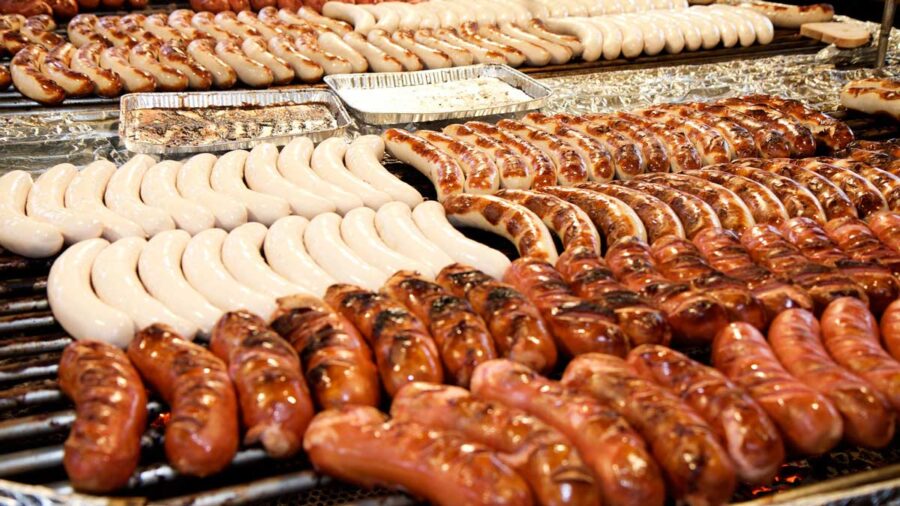
Bratwurst is a fried sausage made of pork and flavored with herbs, nutmegs and onion. Especially Nuremberg is known from Bratwurst. The sausages made there are the smallest of the country, and the Bratwurst of Nuremberg has the name protection of the European Union.

Currywurst is a sausage food invented in Berlin, which is eaten with a tomato paste flavored with curry. It was invented by Herta Heuwer in 1949. The mixture consists of ketchup, Worcestershire sauce and curry powder.

A Bavarian specialty is roast beef with dumpling peels. In the manufacturing process is used, for example, onion, parsley, marjoram, cumin, mustard and egg yolk. At first, the vegetables are cut and fried. Then the yolks are added. The beef is flavored on both sides with salt and pepper and roasted. Finally, the beef is put into the oven in 250 degrees for 5-6 minutes. The beef is served with the vegetables and cress sauce.
[adinserter block=”4″]
German food culture
Breakfast (Frühstück)
Germans tend to drink something hot in the morning, for example coffee, tea or cocoa. Accompanying the drink there is usually bread with various spreads and toppings, such as butter, margarine, marmalade, honey, quark, sausage or cheese. It is also normal to drink a glass of juice and eat a boiled egg. Especially younger people like to eat cereals, and Müsli (a mixture of cereal flakes, nuts, dried fruit and other ingredients) is also very popular. It is mixed with yogurt or milk, and often topped with fresh fruit.
Grosse Pause (great recess) / Zweites Frühstück (second breakfast) / Pausenbrot (recess bread)
Germans use different words to express a meal that is eaten between the main meals. It is not unhealthy, quite the contrary: eating small snacks prevents overeating at lunch and dinner. It is quite normal to eat a snack between breakfast and lunch in German schools, and it is called Pausenbrot or Zweites Frühstück. In Germany, schoolchildren do not generally eat meals at school, so there is quite a long time between breakfast and lunch, which is typically eaten at home. So, the meaning of Pausenbrot is to ensure the students have enough energy and ability to concentrate for the entire morning. Despite the name suggesting bread, it is not necessary. Fruits, yogurt and a Müsli bar are very popular.
[adinserter block=”3″]
Snack (Zwischenmahlzeit)
The snack for adults is called Zwischenmahlzeit. Some other names are Brotzeit (bread time), Vesper and Zweites Frühstück. The English word Snack as well as the word Imbiss are also used, although they refer to actual meals meant to replace main meals, whereas Zwischenmahlzeit is an addition to the main meal.
Lunch (Mittagessen)
Germans eat their main meal traditionally between 12 and 2 p.m. The tradition to eat a warm meal in the evening has become more popular. A typical lunch plate consists of potato salad with sausages and meat balls, noodles with stir-fry, schnitzel with buttered vegetables or fish sticks with mashed potato. Meat is eaten almost daily, especially pork and chicken. Vegetables also are an important part of lunch. Especially green beans, carrots, peas and cabbage are popular. Potatoes are served in different forms: as boiled, dumplings, fried potatoes, croquettes, mashed potatoes and, of course, French fries. Rice and noodles are eaten as side dishes.
Evening Meal (Abendbrot)
Translated literally, Abendbrot means literally evening bread. It is a light meal eaten usually between 6 and 7 p.m., because Germans generally eat their main meal during the day. The evening meal often consists of things like whole grain bread, cheeses, deli meats, sausages, mustards and pickles. Gherkins are also popular. Depending on the season, salad and/or soup can also be served during the evening meal. Young people often drink mineral water or a glass of juice with the meal.
Coffee and Cake (Kaffee und Kuchen)
Kaffee und Kuchen means coffee and cake, and it is very similar to the English tea tradition. Families gather together in the afternoon to drink coffee and enjoy a few slices of homemade cake. Typical cakes are Schwarzwälderkirschtorte (a cherry cake from the Schwarzwald region), Bee Sting Cake (Bienenstich), Käsekuchen (cheese cake made from quark) and different fruit tarts, such Zwetschenkuchen (plum tart) and Apfelkuchen (apple tart). If there is no time to bake at home, many people buy different pastries from bakeries, such as poppy seed pastries or Apfeltasche, an apple-filled strudel-type pastry pocket.
It is quite normal to drink coffee with cream or milk when enjoying cakes or pastries. The popularity of tea has also increased over the last decade, especially in Eastern Friesland, a traditional tea region.
[adinserter block=”12″]
[adinserter block=”1″]
[adinserter block=”2″]